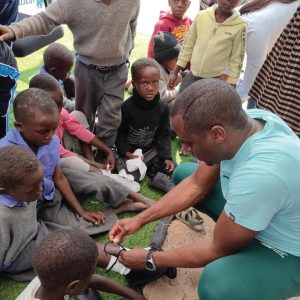
For most Namibians, reliable internet access is still thought of primarily as a convenience, a way to send WhatsApp messages, browse social media or stream entertainment. Yet in large parts of Namibia, connectivity is not merely a luxury. It is infrastructure as essential as roads, electricity and water. In remote communities, a stable internet connection can mean the difference between isolation and opportunity, between delayed medical care and immediate intervention, and sometimes even between life and death.
My own journey into telemedicine began more than a decade ago, long before virtual healthcare became fashionable during the COVID-19 pandemic. In 2012, when we began building what would eventually become OnCall Africa, many people questioned whether meaningful healthcare delivery could truly occur remotely in Namibia. At the time, the concept sounded ambitious, perhaps even unrealistic, in a country where vast distances and sparse infrastructure have historically challenged service delivery of every kind. Yet necessity has a way of forcing innovation.
Over the years, our teams have provided medical support in some of the most remote and unforgiving environments imaginable; from Marienfluss in the far north-west to Noordoewer on the southern border; from Xaudum in the Kavango regions to Hoanib Valley, Chobe and Sossusvlei.
We have worked alongside the tourism industry, mining sector and isolated communities to bridge healthcare gaps using whatever tools were available: satellite phones, patchy mobile or fixed line networks, frugal diagnostics and creative operational models designed specifically for Africa rather than blindly imported from Europe or America.
What became increasingly clear was that healthcare access in the modern world is now deeply tied to digital connectivity. A reliable broadband connection in a remote lodge or mining operation does not simply allow for voice and video consultations. It potentially enables remote ECG interpretation, digital triage, specialist reviews, mental health support, medication management, occupational health monitoring and optimises emergency coordination.
It allows a patient hundreds of kilometres from larger towns to access clinical guidance and care instantly. It allows a tourist with chest pain in the Kunene Region to be evaluated rapidly by a doctor before an unnecessary and enormously expensive evacuation occurs. It allows continuity of care where previously there was only delay.
Importantly, these technologies do not only benefit healthcare.
Connectivity empowers remote communities through access to banking, education, e-government services and entrepreneurship. As far back as 2014, through an initiative called MyDigitalBridge, we explored the use of TV whitespace technology to provide low-cost data coverage across vast distances in Namibia. The vision was simple: create affordable connectivity that could unlock economic participation for communities historically excluded from the digital economy. Unfortunately, despite its potential, the project never obtained the necessary regulatory clearance.
Similarly, we later worked with the Australian drone company Swoop Aero on a UNICEF-funded initiative aimed at supporting emergency medical logistics in flood-prone regions of East Kavango. The project involved the Ministry of Health and the Namibia Institute of Pathology and had the potential to revolutionise access to emergency medicines and diagnostics during seasonal flooding. Yet despite strong stakeholder support, progress became entangled in regulatory uncertainty surrounding beyond visual lineof-sight drone operations and overlapping jurisdictional hurdles.
To be clear, regulation matters. Aviation safety matters. Telecommunications governance matters. Patient privacy matters. No responsible innovator argues otherwise. But there is also a danger in allowing regulation to move so slowly that it unintentionally suppresses the very innovation needed to solve national problems.
Namibia has an opportunity to position itself as a regional leader in digital infrastructure and remote healthcare innovation. Technologies such as low-earth orbit satellite internet services could dramatically improve connectivity in underserved regions where traditional fibre or cellular expansion remains economically difficult. The potential implications for healthcare, mining, tourism, education and rural development are enormous.
This conversation should not be reduced to simplistic debates about foreign companies or regulatory technicalities alone. The larger question is whether we are willing to create adaptive, practical frameworks that balance oversight with progress. Namibia has never lacked innovators. What we have sometimes lacked is the regulatory agility to move at the same speed as the problems we are trying to solve.
At OnCall Africa, we have spent over a decade proving that world-class healthcare innovation can emerge from Namibia itself, designed specifically for the realities of Africa’s remote environments. The challenge now is not whether telemedicine works. We already know that it does. The challenge is whether our regulatory environment will evolve quickly enough to allow its full potential to reach every corner of the country.