
Made in Namibia, by Namibians
August 26 Manufacturing makes garments and footwear in Windhoek and Okahandja—PPC, healthcare and workwear for mining, oil and gas, hydrogen and government.

Small states are often viewed as structurally disadvantaged due to limited domestic markets, external vulnerability, and dependence on trade. Yet the experiences of Singapore and Namibia demonstrate that long-term outcomes are shaped less by size or geography than by institutional quality, policy discipline, and execution capacity. Both countries emerged from colonial rule as small, open economies facing inequality, unemployment, and external dependence. Yet Singapore transformed into a global high-income hub, while Namibia remains a middle-income economy with high unemployment, limited diversification, and rising fiscal pressures. The divergence reflects how institutions translated policy ambition into economic transformation.
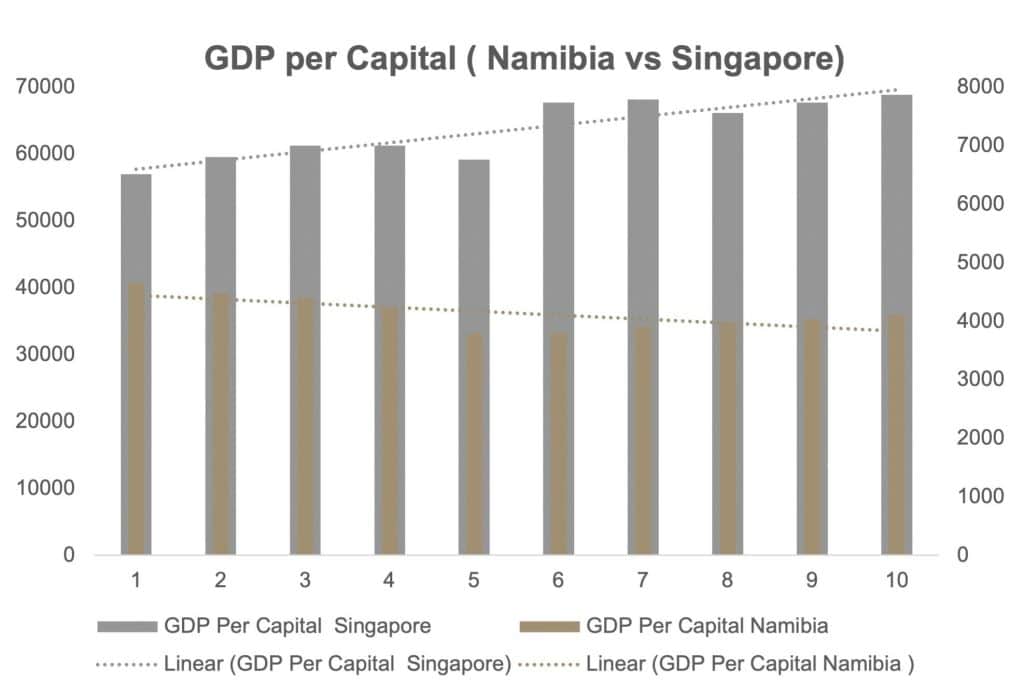
Singapore’s rise remains extraordinary. At independence in 1965, GDP per capita stood near US$500. By 2025, it exceeded US$100,000. Namibia’s GNI per capita today is roughly US$5,000, respectable regionally, but far from Singapore’s structural transformation. The difference is not simply wealth, but economic complexity. Singapore built a diversified economy driven by manufacturing, finance, logistics, and knowledge services, while Namibia remains concentrated in capital-intensive primary sectors with weak employment creation and limited domestic linkages.
At independence, both economies faced structural constraints. Singapore inherited mass unemployment, housing shortages, and no natural resources. Namibia inherited deep inequality, a dualistic economy, and dependence on South Africa. The key difference was urgency. Singapore’s lack of resources forced rapid capability-building, while Namibia’s mineral and natural-resource base provided buffers that reduced pressure for structural reform. Development economics repeatedly shows that resource abundance can delay institutional transformation by easing the urgency for reform.
This issue is increasingly relevant today as Namibia approaches a potentially transformative resource cycle through offshore oil and gas discoveries, critical minerals, and green hydrogen. These opportunities could generate unprecedented fiscal revenues. However, experiences from Angola, Nigeria, and Venezuela demonstrate that resource booms often fail to deliver structural transformation when revenues are absorbed into recurrent expenditure, distributed through patronage networks, or used to delay reform. In such cases, commodity booms create temporary growth followed by fiscal crises and continued economic dependence. The resource curse is not inevitable, but it becomes likely when institutional frameworks are weak, and revenue management lacks transparency and discipline.
Singapore responded to its constraints by constructing a technocratic developmental state centred on credibility, administrative efficiency, and disciplined execution. Industrial policy was pragmatic rather than ideological, supporting sectors that improved productivity and export competitiveness. Over time, the economy moved from labour-intensive manufacturing into electronics, chemicals, logistics, finance, and knowledge-intensive services. This transformation was reinforced through coordinated investment in infrastructure, education, and industrial clustering. Fiscal discipline and policy predictability strengthened investor confidence and enabled Singapore to overcome the disadvantages of smallness.
A major pillar of Singapore’s success was governance. Under Lee Kuan Yew, the civil service was professionalised through competitive salaries that reduced corruption incentives and attracted highly skilled administrators. Anti-corruption enforcement was unconditional, with investigations proceeding regardless of political affiliation or seniority. Appointments across state institutions were based primarily on competence rather than patronage. These reforms created credible commitment: investors and citizens trusted that policies would be implemented consistently and institutions would function predictably.
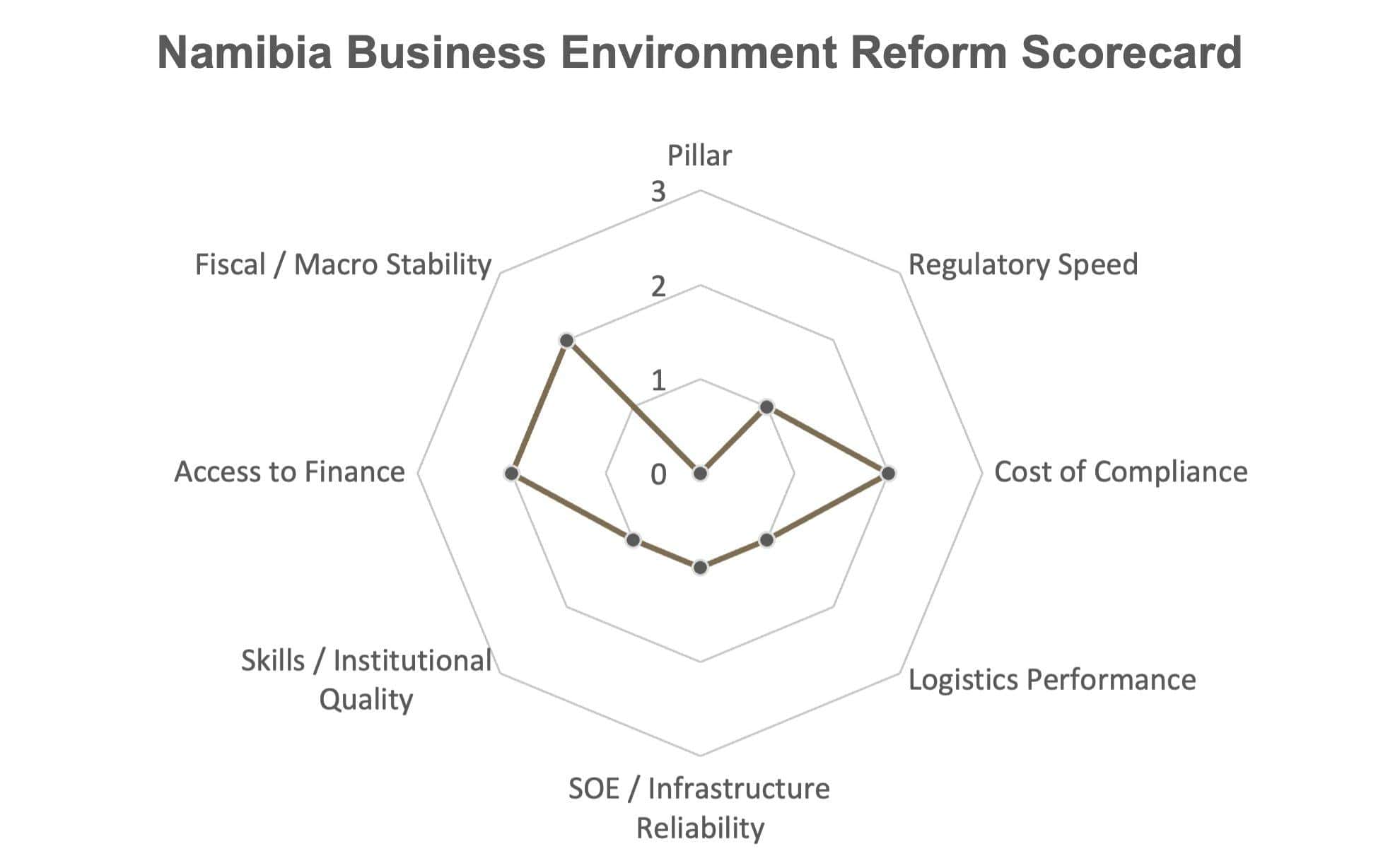
Namibia followed a more gradual social-market approach, prioritising stability, redistribution, and macroeconomic continuity. Inflation remained relatively contained, institutions retained credibility, and the monetary framework anchored expectations. However, the economic structure remained narrow. Mining, trade, and public administration continue to dominate GDP, while manufacturing and tradable services remain underdeveloped. Employment growth has remained weak because dominant sectors are highly capital-intensive and generate limited downstream value chains.
The divergence between the two countries is therefore fundamentally institutional. Singapore consistently converted long-term plans into measurable outcomes through efficient implementation agencies and predictable administration. Namibia, by contrast, often demonstrates a persistent execution gap. Development plans are frequently well designed, yet implementation is slowed by administrative delays, overlapping mandates, and inconsistent enforcement. In a small economy, these inefficiencies carry significant costs because growth depends heavily on institutional reliability.
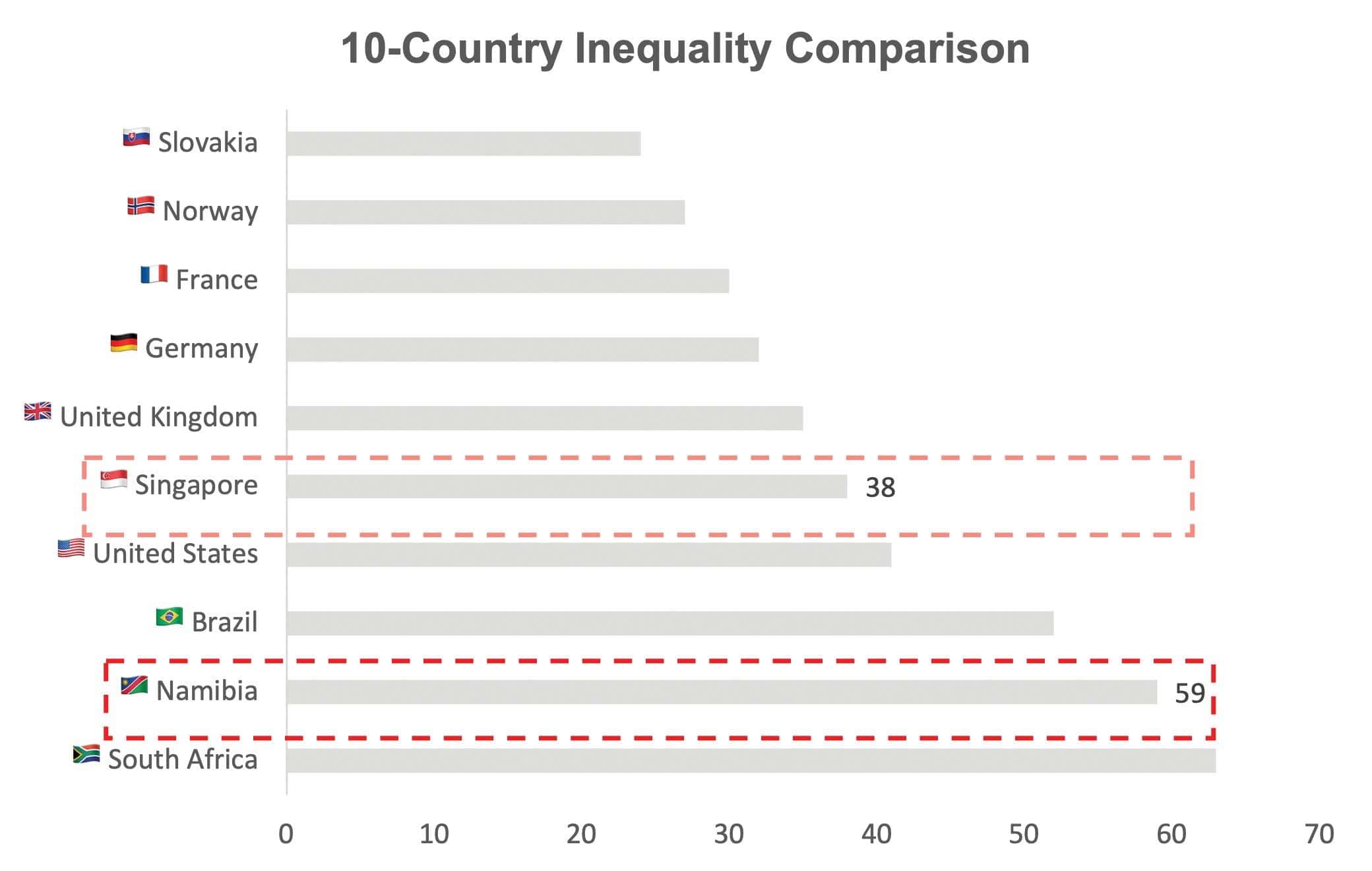
This institutional gap is also reflected in inequality and labour-market outcomes. Namibia remains one of the most unequal countries globally, with a Gini coefficient near 0.6 and unemployment above 30% on the narrow definition. While these inequalities originate partly from apartheid legacies, their persistence suggests that growth has not sufficiently broadened participation in the economy. Access to capital, land, and economic networks remains uneven, while weak enforcement environments risk reinforcing insider advantages through procurement, licensing, and statelinked investment flows.
Human capital further illustrates the divergence. Singapore treated education as the foundation of economic transformation, aligning schools, vocational training, and technical institutions with industrial strategy. Namibia allocates substantial public spending to education, often exceeding 8% of GDP, yet graduate unemployment remains high, and firms continue relying on imported technical and managerial skills. The issue is therefore not only spending levels but alignment and effectiveness. Education drives transformation only when it produces capabilities demanded by future industries.
Fiscal strategy also highlights important differences. Singapore embedded fiscal conservatism into governance and accumulated public assets through sovereign investment vehicles. These reserves strengthened resilience and funded long-term infrastructure development. Namibia’s debt burden, by contrast, has risen sharply to around 70% of GDP, while a large wage bill and rigid recurrent expenditure constrain development spending. As Namibia approaches a resource revenue cycle, the institutional framework governing these revenues will be decisive.
Norway and Singapore provide important examples. Norway’s Government Pension Fund Global and Singapore’s GIC and Temasek Holdings demonstrate how disciplined accumulation of public assets can ensure intergenerational equity and macroeconomic stability. Both countries treated resources and accumulated wealth as long-term assets rather than immediate income streams. Namibia will require similar rules-based savings mechanisms, transparent reporting frameworks, and investment mandates focused on productivity-enhancing assets rather than permanent consumption.
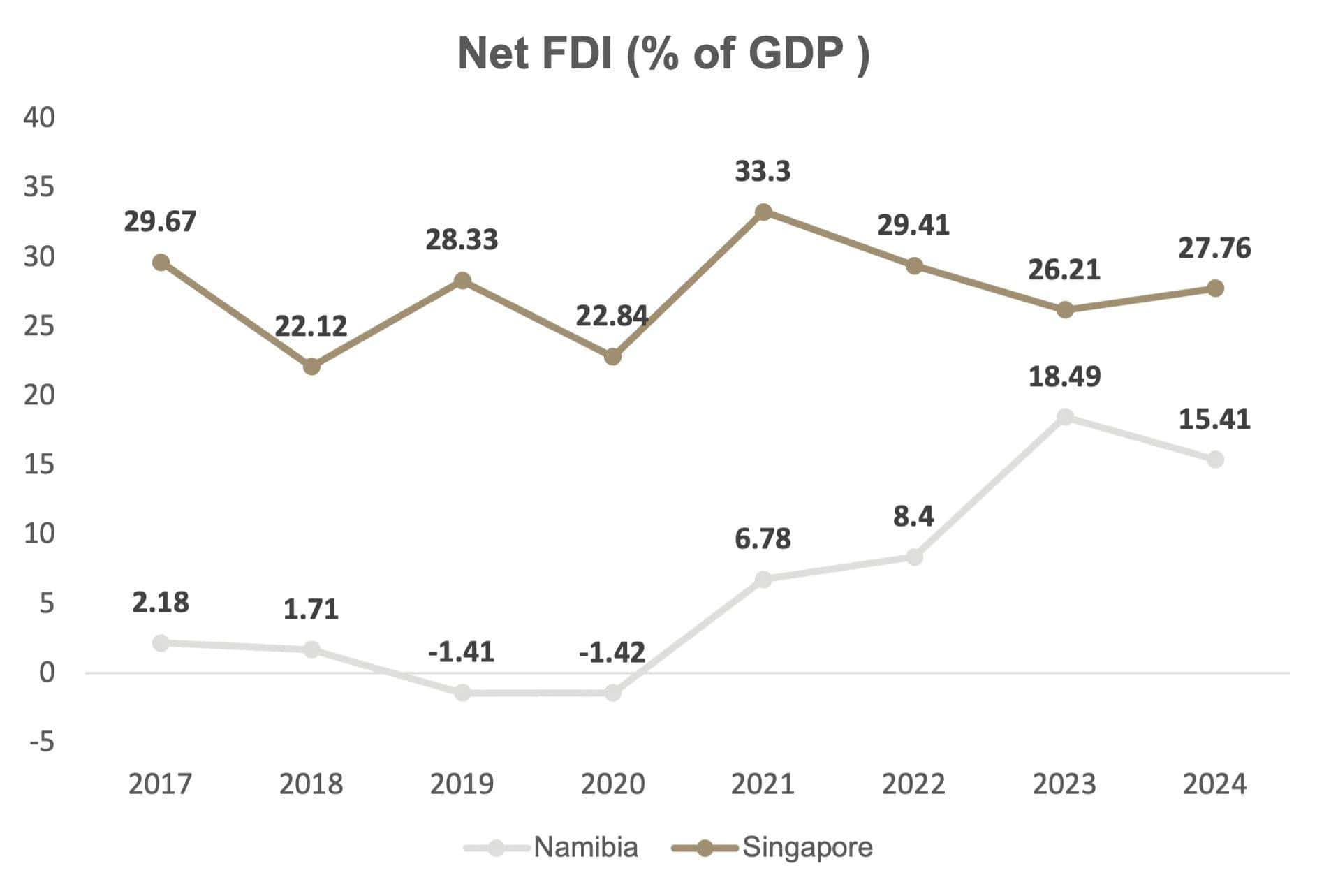
Singapore’s experience also demonstrates the importance of strategic openness to foreign investment. Foreign firms were used not as substitutes for domestic capability, but as vehicles for technology transfer, export integration, and skills development. Namibia faces a similar opportunity today. High-quality foreign investment in manufacturing, logistics, renewable energy, and tradable services could accelerate productivity growth and reduce dependence on commodity exports, provided such investment includes local supplier development and workforce upgrading.
Ultimately, the Singapore-Namibia comparison leads to a simple conclusion: development outcomes are determined less by resource endowments than by institutional discipline. Singapore achieved prosperity through meritocracy, execution, and long-term policy consistency despite lacking natural resources. Namibia possesses advantages Singapore never had, including minerals, land, and strategic positioning. The challenge is ensuring that resource abundance strengthens rather than weakens reform momentum.
Four priorities therefore emerge as decisive for Namibia’s future. First, strengthening implementation capacity through meritocratic and accountable public institutions. Second, aligning education and vocational systems with future industries. Third, managing resource revenues through transparent, rules-based frameworks focused on longterm asset accumulation. Fourth, using foreign investment strategically to transfer skills, technology, and productive capabilities into the domestic economy.
Singapore’s lesson for Namibia is not that transformation is easy, nor that models can be copied directly. It is that sustained institutional discipline over decades can overcome structural constraints that initially appear insurmountable. Development is ultimately shaped not by destiny or resources, but by the quality and consistency of governance choices.
Simonis Storm is known for financial products and services that match individual client needs with specific financial goals.
August 26 Manufacturing makes garments and footwear in Windhoek and Okahandja—PPC, healthcare and workwear for mining, oil and gas, hydrogen and government.

With youth joblessness at 44.4%, Namibia cannot recruit its way out of a skills gap. Leadership means first chances, local contracts and real knowledge transfer.

At AGIS 2026 in Swakopmund, Namibia set green industrialisation as a jobs strategy—hydrogen, iron and ammonia under NDP6, not just raw-material exports.

First oil is not the starting line. At NOGC 2026, Namibia’s energy talk shifted to readiness: local content, joint ventures and capability before procurement.