
Where conservation meets community
In Lüderitz, community makers are building penguin and gannet decoys to lure seabirds back to silent islands in Namibia’s NIMPA

Global headlines about El Niño tend to focus on Pacific sea-surface temperatures and probability percentages. For a small, importdependent economy like Namibia’s, the number that matters more sits thousands of kilometres away, on a maize farm in South Africa’s Free State. That distinction is the difference between reading this year’s forecast correctly and reading it wrong.
Start with what is actually confirmed, rather than forecast. NOAA’s Climate Prediction Center assigns an 81% probability that the current El Niño reaches “very strong” intensity between October and December 2026, and a 97% probability that conditions persist into early 2027. But the region’s own expert panel, the SAWS and ARC ENSO Reference Group, classified the event as of 23 July 2026 as merely “moderate” and strengthening, not yet strong or very strong. That gap between a confident forecast and a more cautious present-tense reading is the first thing anyone assessing Namibia’s exposure should hold onto.
Namibia has lived through three major El Niño droughts since 1991, and each one has told the same story slightly differently. In 1991/92, the worst drought of the twentieth century, consumer price inflation rose from 13.5% to 21.6% as crops failed and livestock died across the country. In 2015/16, food inflation more than tripled, climbing from 4.1% to 13.2% inside little more than a year. And in 2023/24, the most recent episode, food inflation barely moved at all, rising from just 4.3% to 6.4%.
Three droughts, three very different outcomes, and domestic agricultural output collapsed by a broadly similar magnitude in both 2015/16 and 2023/24. The more interesting explanation for the very different inflation results is that Namibia’s food-price outcome has never depended only on Namibian rainfall. In 2024, as the domestic harvest failed, Namibia leaned hard on imported maize from South Africa, with imports surging 46% to a record high. That channel did much of the work of keeping food inflation contained. Rainfall timing, exchange-rate movements and the government’s own policy response all played a part too, since a sample of two episodes cannot cleanly isolate one cause, but the scale of the import response is hard to ignore.
This matters because Namibia’s exposure to South Africa runs far deeper than most people realise, and it is not just about maize. On customs data, roughly 38% of Namibia’s imports originate in South Africa. Bank of Namibia balance-of-payments figures, which capture indirect trade and goods re-routed through South African ports, put the real figure at 60 to 66%. Refined petroleum, motor vehicles, pharmaceuticals, chemicals and cereal products are all sourced predominantly from or via South Africa. Namibia, South Africa, Eswatini and Lesotho also share a customs union and a common monetary area, which keeps transaction costs low but means Namibia absorbs South African price and policy shocks with almost no friction or buffer. Most of what Namibia consumes crosses the border priced in Rand, in an economy permanently pegged oneto-one to the currency next door. There is no exchangerate movement between the two currencies to transmit anything; the actual channels are shared import prices, common regional monetary conditions, and the Rand’s own moves against the rest of the world.
Which is why the most useful question for 2027 is not how much it will rain in Namibia, but how exposed South Africa’s own maize crop is this time. Namibia’s own seasonal rainfall outlook for the critical October 2026 to March 2027 window has not yet been published by the Namibia Meteorological Service or the regional climate forum SARCOF. A University of the Western Cape study on Namibia’s currency peg found the two countries’ inflation rates are positively correlated with no statistically significant difference between them, and Namibia’s transport inflation already reached 12.9% year-on-year in June 2026 as fuel prices swung sharply, closely tracking a comparable move in South Africa’s own fuel index.
Namibia enters this cycle with less room to absorb a shock than it had even eighteen months ago. The country’s cattle herd is still rebuilding from the last drought: marketing volumes were up 34.4% year on year in the first quarter of 2026, with retention rates running near 60% against a normal 2 to 5%, as farmers hold back breeding stock rather than sell. A second destocking cycle before that rebuilding is complete would cost considerably more than the first one did. Fiscally, the government has already spent roughly N$1.86 billion, around 0.7% of nominal GDP, on drought relief across the 2024/25 and 2025/26 financial years. And the Bank of Namibia lifted its repo rate to 6.75% in June 2026, partly in response to an unrelated oil price shock, leaving less room to cut rates if a fresh food price shock arrives on top.
The exposure is not evenly spread across the economy. Communal livestock farmers and commercial rain-fed crop growers sit at the sharp end, alongside the banks and agricultural lenders who finance them, where livestock collateral values and borrower cash flow have historically come under pressure together. Grain importers, transport operators, and solar and irrigation suppliers, by contrast, tend to see higher volumes when Namibia leans harder on imports and adaptation, as it did in 2023/24.
Namibia is not alone in facing this risk. A continent-wide assessment rates Namibia’s overall vulnerability to this El Niño as Moderate to High, meaningfully above South Africa and Botswana but well below Zambia and Mozambique, which carried Very High ratings through the 2023/24 episode. Both have since recovered a great deal of ground: Zambia’s 2025/26 maize harvest is forecast at a record 4.9 million tonnes, up from just 1.5 million tonnesat the depth of the 2024/25 drought, and the water level behind the Kariba Dam has climbed back to 48% of usable storage, from just 13% two years ago.
None of this amounts to a forecast that Namibia is heading for a repeat of 2015/16, let alone 1991/92. The evidence points instead to a genuine fork in the road. A milder path resembles 2023/24, in which an adequate South African harvest again cushions the shock. A central case sees below-normal local rainfall and a weaker South African crop push food inflation up by perhaps four to nine percentage points. A more severe tail risk would see consecutive poor seasons and regional electricity strain combine with a sharp maize price spike, forcing a fiscal response on the scale of 2024’s emergency programme.
The single most useful thing to watch between now and the end of the year is not Namibia’s own sky, but South Africa’s fields, and the maize price that sets the tone for both countries’ food inflation long before Namibia’s own harvest is in the ground.
From the September 2026 issue
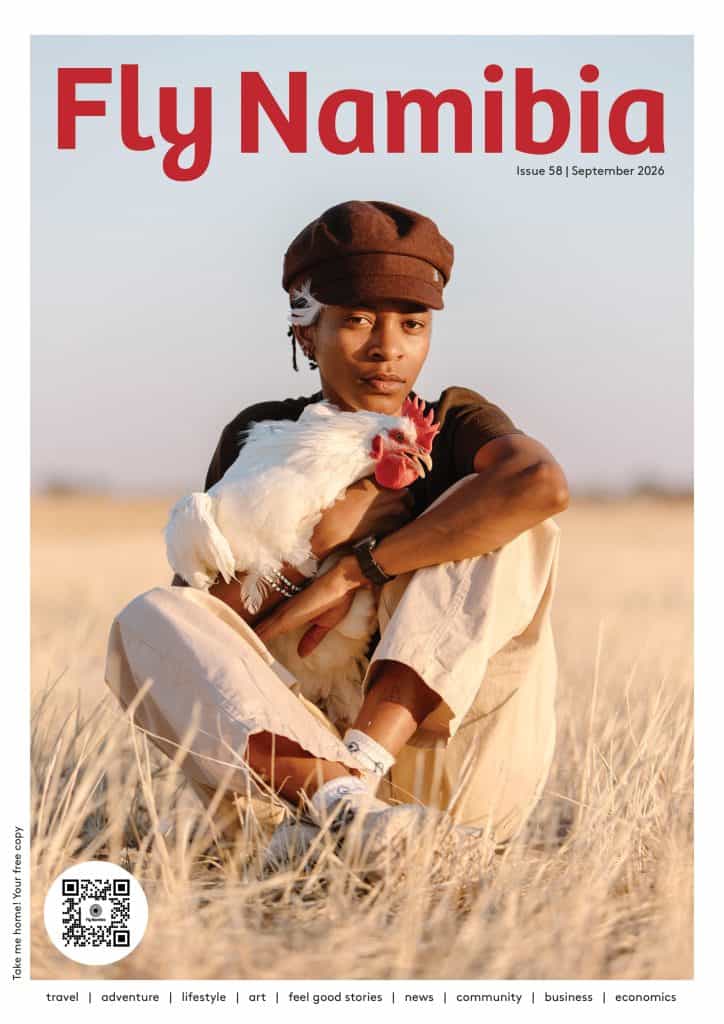
In Lüderitz, community makers are building penguin and gannet decoys to lure seabirds back to silent islands in Namibia’s NIMPA

Clocks do not measure an independent flow called time. They count physical cycles. Relativity’s “time dilation” is a change in

FlyNamibia’s “We rise by lifting others” in action: We’re for Namibians stories, the Makers Project and Padel for a Purpose

“I don’t know” is often “I’m not ready to face what I know.” On intuition versus fear — and the