Ten years ago, toddlers had become a nuisance and a disturbance to Festus Mbangula of Ondangwa. Because he had a niece and nephew, then aged 3 and 5, in his home, children from neighbouring houses would always come to play with them in his yard.
“They became a nuisance because every morning when their parents left for work, they would come to play with my niece and nephew. By that time, I was busy doing some vehicle repairs in my yard, and they were always disturbing me and my assistant,” Mbangula remembers.
One day, a customer who had brought his vehicle for repairs asked him if all the children were his. “After I told him only two were from my house, he jokingly told me it would be better for me to start a kindergarten to keep them under control. This was after one of the children had spilled a whole 5-litre container of engine oil intended for that man’s car.”
After considering the noise and mayhem caused by the children each day, Mbangula took his customer’s advice seriously.
“All the children were from the neighbourhood. The parents all knew me. They did not have a problem with their children spending their days at my house because we had a boundary wall and it was secure,” he says.
Mbangula approached his neighbours with the idea of establishing a kindergarten at his house to keep the children busy. “They liked the idea, but many of them were worried about where we would get a teacher. There was a Zimbabwean national who was teaching at a nearby private school, and he had a brother who was at home doing nothing. So, I approached them and asked the brother to assist us with the kindergarten.”
“I told him there would be no fixed salary, but parents would be providing a few dollars for him to keep body and soul together.” To Mbangula’s surprise, he agreed and stepped in to help.
In the beginning, a simple corrugated iron structure with a zinc-sheet roof was erected to provide basic shelter. During a visit to a local government school, he also acquired an old chalkboard, helping to create a modest learning space.
“I informed the parents to get books, newspapers and magazines, whether new or old. Anything readable, pencils and crayons. I told them to buy kiddies chairs for their children and to prepare lunchboxes for them each school day,” he notes, further adding that parents were also requested to pay a monthly N$100 contribution to remunerate the volunteer teacher and buy chalk and other necessities.
After these preparations, Afrikan Child Kindergarten officially opened its doors with seven children and one teacher in April 2016. Mbangula continued with his vehicle repair work, while the teacher looked after the kids.
Fortune smiled on them in late 2016, when the Social Security Commission (SSC), through its social corporate investment wing, granted a donation of N$90,000 towards education and construction. “One journalist happened to write our story in the local daily newspaper. The SSC contacted us and subsequently donated the sum of money. I think they were intrigued by a male teaching in a kindergarten – something which was somehow still strange in these parts of the country,” he reflects.
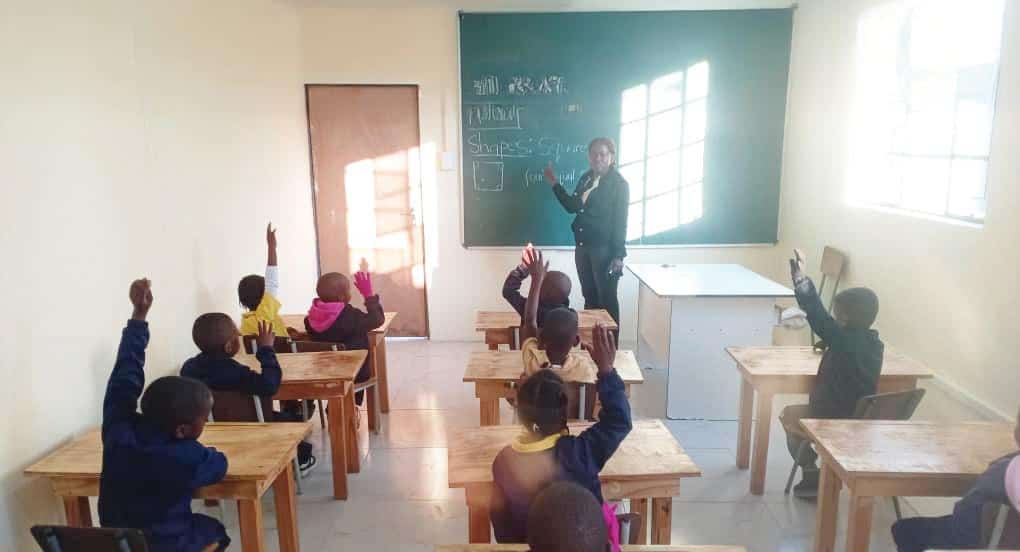
Mbangula notes that the SSC donation empowered the kindergarten, improving and enhancing teaching and learning. “We built two proper classrooms, bought chairs for the children and teacher and we bought stationery as well. The SSC donation was such a blessing. We would not be where we are today if it were not for them. We are very much grateful to them,” he says.
Today, the kindergarten has 57 children, two teachers, a caregiver and a housekeeper. “We have grown tremendously over the past ten years. We have children coming from all over Ondangwa and surrounding villages. Our teachers are qualified and certified to teach kindergarten children, and they attend training now and then,” he points out.
Mbangula plans to expand the school to start offering grades 0 to 3. “We are awaiting approval from the Ministry of Education to offer those grades. If all goes well, by next year we will be offering grades 0 to 3, and our children will be attending all those grades here,” he shares excitedly.
Mbangula remains the director of the school while he continues with his vehicle repair work on the same yard. “I know nothing about education, so I keep in my lane. The teachers deal with the school. I only provide direction, advice and guidance. They are running the show. But we also work together with the parents to ensure that we improve things at the school,” he says, stressing that he involves parents in the school’s activities as much as possible.
“During graduation ceremonies for the children, for instance, teachers and parents are the ones organising. They do everything. My role is very much limited, and I plan to keep it that way in the future also,” he humbly concludes.