Mobilising climate finance for Namibia’s sustainable future
Namibia is advancing its sustainable finance agenda as RMB Namibia and the Bank of Namibia lead efforts to unlock climate finance, attract investment, and support
By Maggie Forcelledo Paz
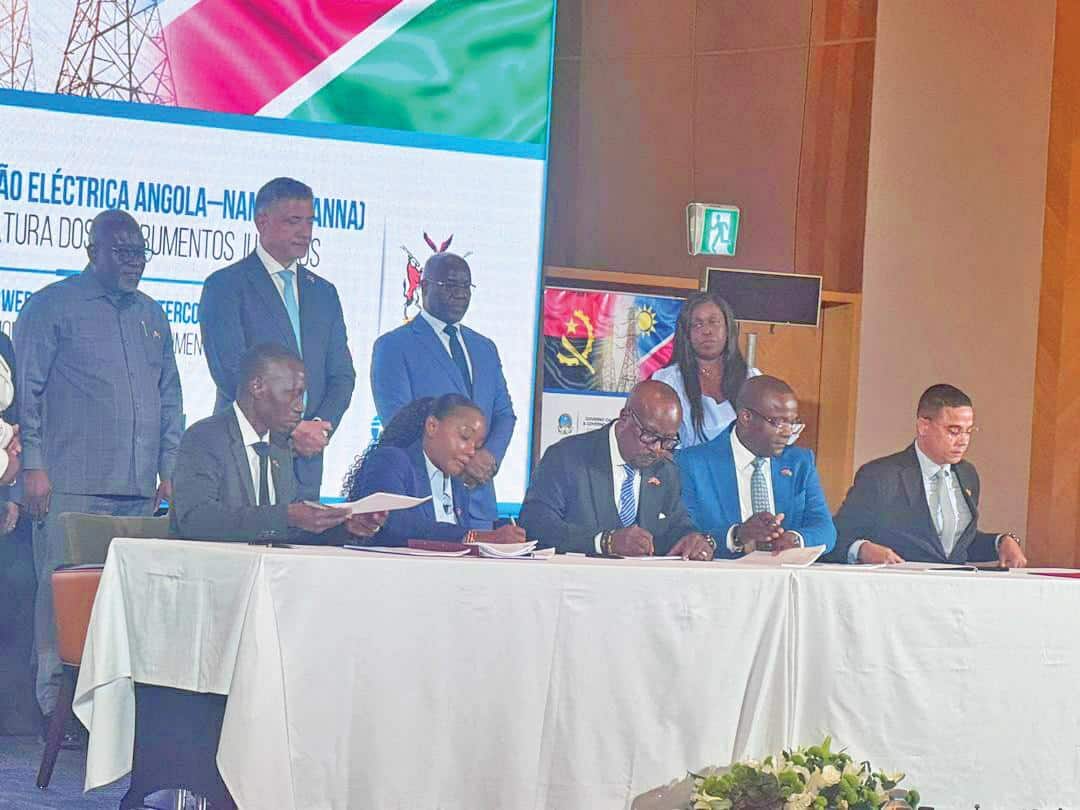
Namibia and Angola have taken a major step towards strengthening regional energy security and economic cooperation with the signing of a power purchase agreement (PPA) and joint development agreement (JDA) for the Angola– Namibia Interconnector Transmission Line, widely known as the ANNA Project. The agreements were concluded between the respective national electricity transmission utilities, Rede Nacional de Transporte de Electricidade (RNTEP) of Angola and NamPower of Namibia, both of which are responsible for the management and operation of their countries’ electricity transmission networks. According to the Office of Information Technology, Institutional Communication and Press under the Ministry of Energy and Water (MINEA) in Luanda, the implementation of the ANNA Project is being coordinated alongside the Huíla– Cunene Interconnection Project (HCIP).
Speaking at the signing ceremony in Luanda, Namibia’s Minister of Industries, Mines and Energy Modestus Amutse described the agreement as a significant milestone in advancing bilateral relations between the two countries. “This milestone signifies the strength of the bilateral relations between the Republic of Namibia and the Republic of Angola, specifically in deepening our shared commitment to the cooperation in the energy sector and to promote our common vision of regional integration, energy security and sustainable development,” said Amutse.
The project, once completed, will link Angola’s electricity network to Namibia and the broader Southern African Power Pool (SAPP), and is expected to enhance regional connectivity, boost cross-border electricity trade and support long-term sustainable development.
The ANNA Project is a major regional energy infrastructure initiative designed to physically connect the electricity grids of Namibia and Angola. It is a high-voltage transmission line which will run from southern Angola into northern Namibia, enabling electricity to flow between the two countries. SAPP was established in 1995 under the Southern African Development Community (SADC) to improve energy security, reduce costs and promote regional integration. It forms part of Africa’s long-term goal of creating a continent-wide electricity market where power can move freely across borders.
Cabinet has committed approximately N$4 billion towards the project, covering the engineering, procurement and construction phase from Cahama in Angola to Kunene in Namibia, along with associated infrastructure within Namibian borders. “For Namibia, securing reliable, affordable and sustainable electricity remains a national priority,” Amutse said, adding that the project will help diversify the country’s energy mix and reduce supply risks amidst growing demand.
Amutse further highlighted that regional energy cooperation remains critical within the framework of the SADC, noting that collaborative projects such as the ANNA interconnector are essential in addressing shared challenges related to energy security, economic growth and climate resilience.
It envisions a peaceful, inclusive and competitive region that is industrialised and progressing towards middle- to high-income status, where all citizens enjoy sustainable economic wellbeing, justice and freedom.
Against this backdrop, the ANNA Project is expected to play a transformative role in the region by improving electricity access, strengthening industrial development and advancing economic integration between Namibia, Angola and the wider Southern African region. The next phase will involve the contracting of construction works and supervision services, as well as the implementation, execution and commissioning of the interconnector, ultimately paving the way for its entry into commercial operation.

Namibia is advancing its sustainable finance agenda as RMB Namibia and the Bank of Namibia lead efforts to unlock climate finance, attract investment, and support

Discover how Miss Namibia is empowering communities across the country by creating opportunities for SMEs, service providers, creatives and young professionals. From hairstylists and caterers

Can Namibia follow Singapore’s path to prosperity? This analysis explores how institutional quality, governance, education, foreign investment and resource management will determine whether Namibia’s emerging

Namibia has launched the Work Integrated Learning (WIL) Policy 2025–2030 to strengthen graduate employability, bridge the gap between education and industry, and support skills development,