We rise by lifting others: Championing the Namibians who make Namibia extraordinary
FlyNamibia’s “We rise by lifting others” in action: We’re for Namibians stories, the Makers Project and Padel for a Purpose
A few weeks ago I was scrolling through Facebook when I saw a post that completely took the wind out of my sails – a friend of mine had killed himself!
He was not the first friend I have lost to suicide but for some reason his death hit me even harder than I expected. I knew that he had gone through hard times and had battled with mental health issues for some time. In fact he and I had even spoken about some of his struggles in the past, sharing experiences and trying to help him see some kind of light at the end of the tunnel. I know that talking about something once is not a cureall and that something as pernicious as mental health is an ongoing battle, which is what makes it such a difficult thing to combat, but I still felt – if not responsible – in some way guilty of not having done enough to help him.
September is Suicide Prevention Month, and while I have never seen myself as, or particularly wanted to be, a campaigner for anything, I have at the same time always felt that, seeing as I have a platform to speak about things that matter, both here and on the radio, I have a responsibility to do so.
It is estimated that between 720,000 to 746,000 people die by suicide annually at a mortality rate of 9.0 to 9.1 deaths per 100,000 people. Namibia, meanwhile, had a suicide mortality rate of 9.7 deaths per 100,000 in 2022/23, with data suggesting it has risen even higher in recent years. Figures for 2026 are hard to come by but, speaking at the commemoration of World Mental Health Day last year, Prime Minister Dr Elijah Ngurare said that in 2023/2024, a total of 542 cases of suicide and 2,937 attempts had been reported.
The Minister of Health and Social Services last year tabled the Mental Health Bill 2025 (adopted by the National Assembly on 9 June 2026 but yet to be considered by the National Council) with a view to transforming mental health care in Namibia. It remains a serious challenge though, because, as Thanises & Meshelemiah noted in a paper published in 2024, “The number of mental health professionals in Namibia pale in comparison to those in need of mental health services”
“I know that talking about something once is not a cure-all and that something as pernicious as mental health is an ongoing battle, which is what makes it such a difficult thing to combat…”
Namibia is of course not unique in this regard, joining the rest of sub-Saharan Africa in facing what the United Nations Children’s Fund and World Health Organisation said is “a dire shortage of mental health professionals, with only one psychiatrist available per one million people”. UNICEF and the WHO also pointed out that “financial investment in mental health across SSA has been significantly low” at “only one-quarter of the WHO recommendation”.
While the new Health Bill proposes “promoting communitybased care and integrating mental health into primary health services”, access still remains a challenge for many Namibians, with mental health services often located very far away and spread far too thin. Even private patients in major cities have difficulty at times accessing and paying for mental health services, with private practitioners often fully booked and medical aids limiting their funding for counselling.
Things are getting better, though, and with 2026 the final year of the International Suicide Prevention Month triennial theme of “Changing the Narrative on Suicide”, and the call to “Start the Conversation”, people are starting to talk more openly about suicide and mental health. More avenues for getting help are also opening up and, perhaps because more and more people have had to face suicide so frequently in recent years, many of the taboos and preconceptions about the subject are being dismantled.
Bringing things back to my friend, and that terrible afternoon when I saw the news of his death, I hope that – if you ever find yourself in the position he did – you have someone you can talk to, something to hold on to, and a reason to stay.
I hope that, until next time, you enjoy your journey. And remember, if you are in need of someone to talk to, you can reach out to organisations like:
Lifeline/Childline Namibia: +264 61 232 221
The Mental Health Centre at the Windhoek Central Hospital: +264 61 203 9111
The Delivery Room Foundation: deliveryroom.org
Wingman Namibia: wingmannamibia.com
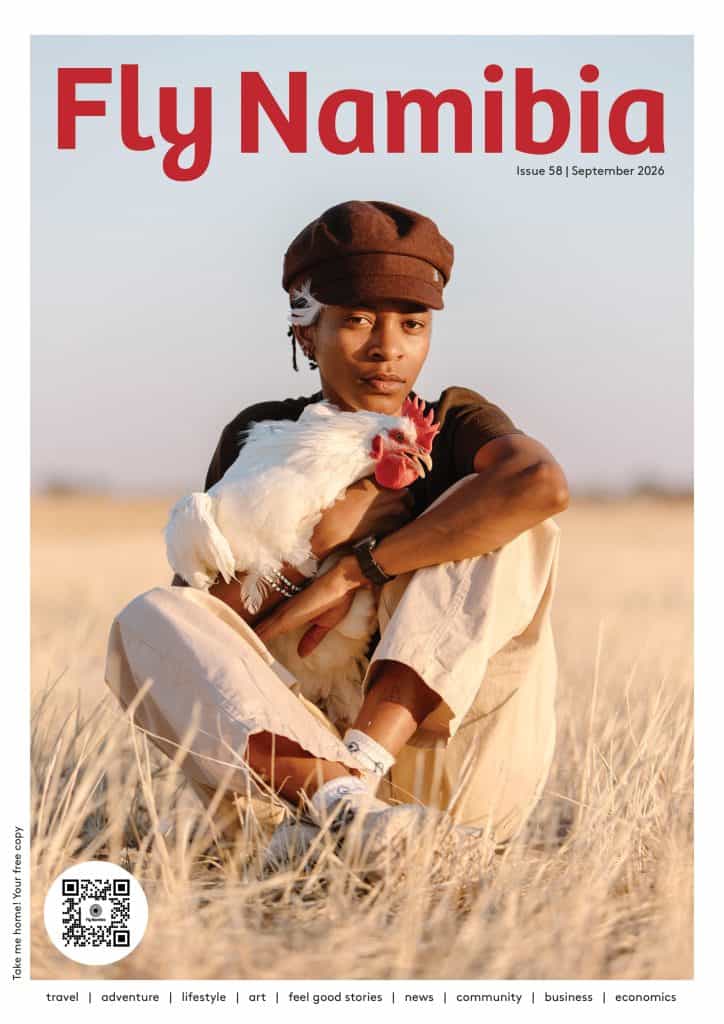
From the September 2026 issue

FlyNamibia’s “We rise by lifting others” in action: We’re for Namibians stories, the Makers Project and Padel for a Purpose

“I don’t know” is often “I’m not ready to face what I know.” On intuition versus fear — and the
Meet FlyNamibia Maker Kanyanga Paulus Simaho, the UNAM Arts student turning recycled materials into handmade Namibian art, aircraft models and

School readiness is more than letters and sitting still. Educational psychologist Jana Vermeulen on the invisible backpack every child carries