
Mapping Namibia’s creative industry ecosystem
CIIA’s Creative Industry Guide 2026/27 is mapping Namibia’s creative economy — who works, where, and what they need — so
Travelling from Ohangwena through the Kavango and up to the Zambezi Region, I am reminded of the fact that the trees here are much bigger than in the rest of the country – an observation I made as a student more than a decade ago during a field excursion. Apart from the fact that the type of trees that grow here are just generally bigger and taller, the average size of the trees growing in these regions is simply bigger in comparison to the same trees in other regions.
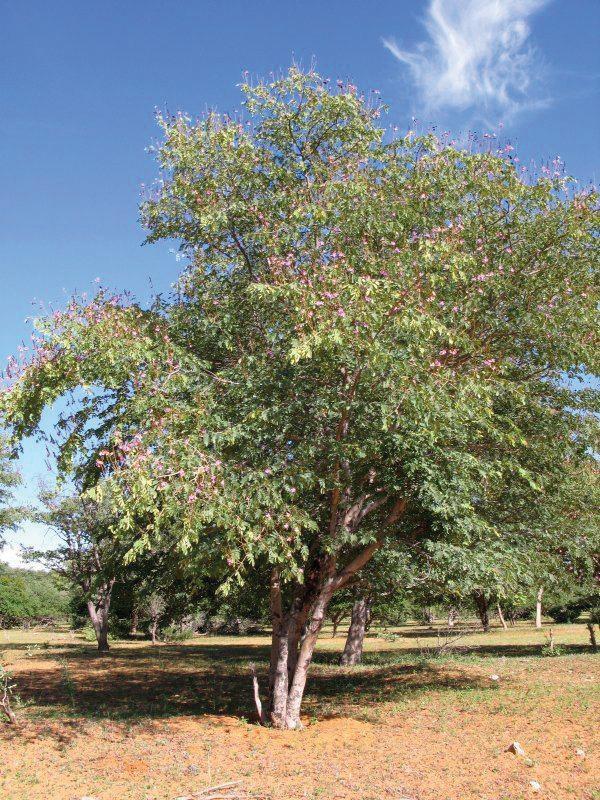
The Zambezi teak is one of those big trees. A tree with a spread crown and a long, thick stem, it is known to grow in the northeastern part of Namibia but can be spotted in areas around Ruacana in the Omusati Region. This is probably owing to the soils in both these areas, as well as the high rainfall. The soils here are organic-rich sandy soils, and the rainfall can be extremely high, sometimes resulting in floods.
The Zambezi teak can grow to a height of up to 20 metres. The surface of its bark is usually grey, becoming rough and scaly, flaking off gradually. The flakes are edible to goats and cattle. The leaves of this tree are slightly broad and alternate with between four and six paired leaflets. Their colour is dark green on the upper surface while the lower surface is pale green. Nature chose a rather leathery texture for them.
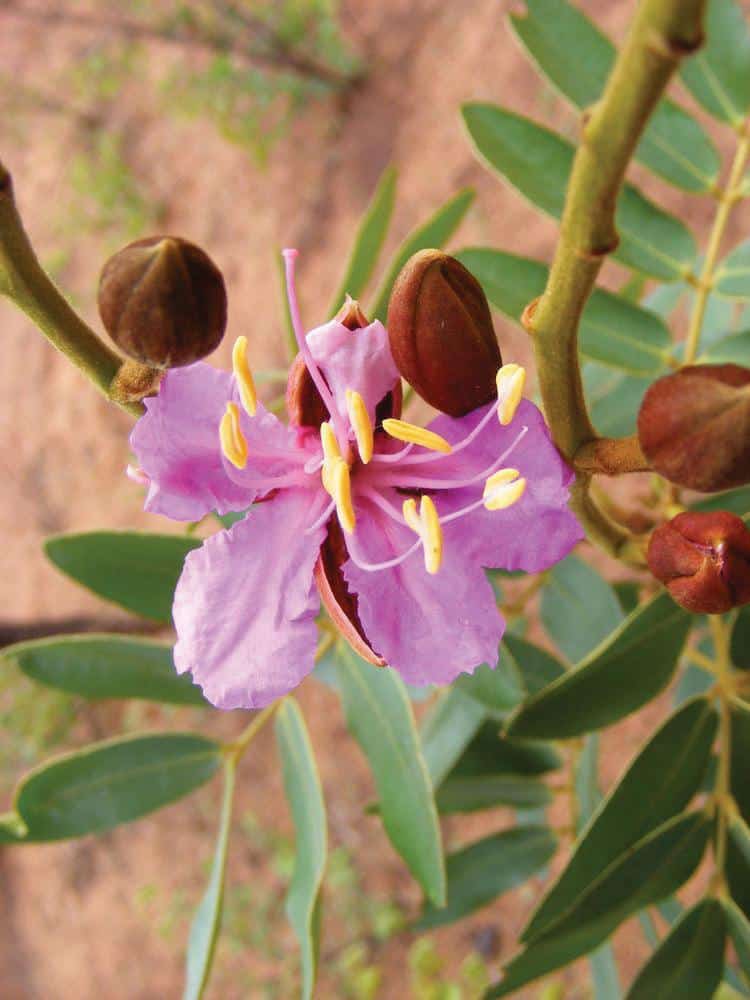
Flowering of the Zambezi teak occurs from November to May, with the peak flowering season known to be during March and April. The tree produces flowers that are pinkish or light purple. Petals of the Zambezi teak happen to be crinkled in shape, especially at the end. It then develops pods that can be compared to those of the camelthorn except that they are brownish. These flat and woody pods are known to split open with a little popping sound when ripe. This splitting shoots seeds in different directions – a rather unique seed dispersal method.
The Zambezi teak is well-known for producing excellent wood. This unique wood becomes dark red with black marks when it dries. It is quite hard and heavy when dry, which makes it suitable for constructing houses, as firewood, pestles for pounding, canoes, furniture and wooden dishes. The wood is also good for making utensils and a popular choice for artisans making the beautiful carvings we often buy in our local curio shops or at vendors along the roads. But the uses of this tree go beyond handcrafted products.
Its bark is recorded to be of great use in home remedies – one of the most common being the treatment of colds, where it is usually boiled until the water turns red. This colour comes from the pigment contained within the bark. The boiled water is then drunk after it has cooled. It is further recorded that the bark is boiled in salt water, cooled and used for the treatment of measles, whereby the liquid is taken orally or as a poultice. While these are all proven traditional methods, it is advisable to consult a medical doctor if there is no supervision of expert healers who are familiar with these home remedies.
The Zambezi teak is often heavily utilised for its timber. Knowing that our native trees take years to mature, let us remain hopeful that we will soon have reforestation initiatives within our communities that know what to plant, where to plant and in what quantities to do so in a way that does justice to our underground water resources. Because protecting our trees not only preserves our ecosystems; it equally preserves our cultures.
From the September 2026 issue

CIIA’s Creative Industry Guide 2026/27 is mapping Namibia’s creative economy — who works, where, and what they need — so

Cleanup Namibia, founded by Dr La-Toya Mwoombola-Hamutenya, turns a neighbourhood walk into a national clean-up. First Windhoek activation: 19 September

In Lüderitz, community makers are building penguin and gannet decoys to lure seabirds back to silent islands in Namibia’s NIMPA

Clocks do not measure an independent flow called time. They count physical cycles. Relativity’s “time dilation” is a change in