Namibia and South Africa push for stronger economic integration

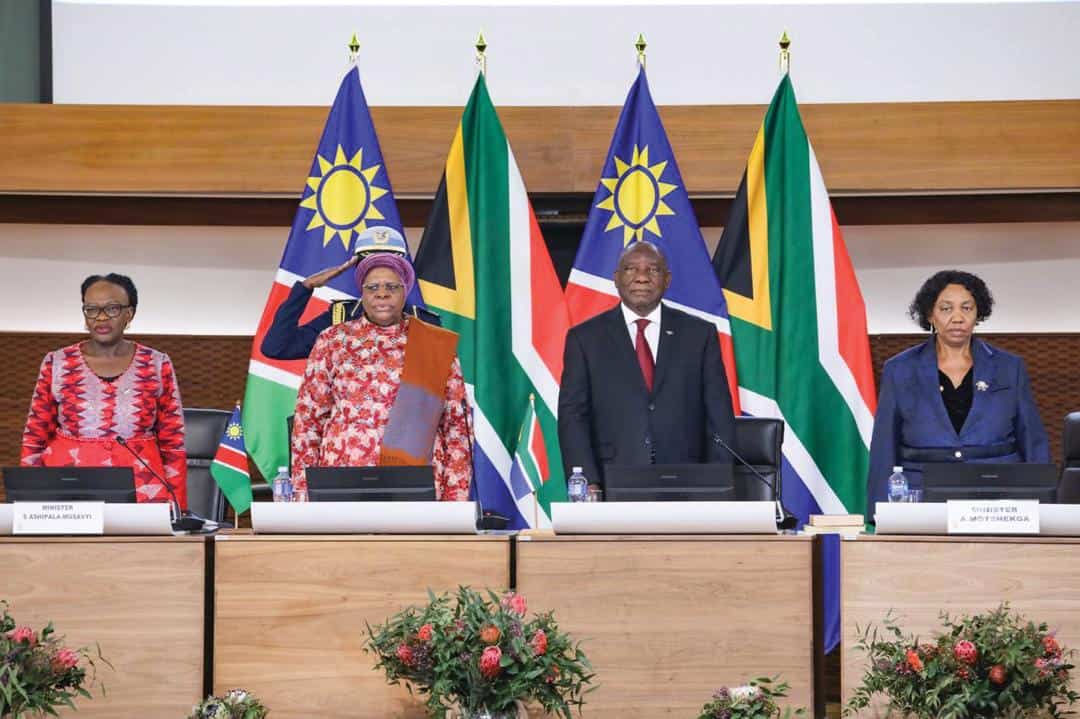
Presidents Netumbo Nandi-Ndaitwah and Cyril Ramaphosa co-chaired the fourth session of the Namibia–South Africa Bi-National Commission (BNC) in Pretoria, pledging to accelerate the implementation of key development projects, enhance regional integration and address longstanding bilateral matters for the benefit of both nations.

President Nandi-Ndaitwah described Namibia and South Africa as sister republics bound by a shared liberation history, saying the BNC was established not only to preserve historical ties but to deliver tangible economic benefits for the people of both countries, stressing that good neighbourliness should continue to guide bilateral relations and cooperation.

Energy cooperation featured prominently during the discussions. Namibia proposed formalising plans to transmit electricity from Angola through Namibia to South Africa, describing interconnected energy infrastructure as essential for regional industrialisation, market integration and sustainable economic growth. Nandi-Ndaitwah also welcomed future cooperation in nuclear energy once Namibia has finalised its legal and policy framework.

One of the key issues raised during the summit was the long-standing Orange River boundary dispute. “As good neighbours, guided by the principle of good faith under international law, we have engaged constructively on the matter of the Orange River boundary, and it is my sincere hope, Comrade President, that we will, in due course, urgently find a solution to this long-standing matter between our two countries to create legal certainty not only for ourselves but also for future generations,” said NandiNdaitwah.

The leaders further reaffirmed their shared positions on regional and global issues, including support for the people of Palestine and Western Sahara, the lifting of the embargo against Cuba, and efforts to restore peace in conflictaffected African countries.

Signed agreements

Bilateral agreements and instruments of cooperation between the two nations include:

  • Memorandum of Understanding (MoU) in the field of employment and labour.
  • MoU between the National School of Government of the Republic of South Africa and the Namibia Institute of Public Administration and Management (NIPAM).
  • Bilateral air services agreement.
  • MoU on cooperation in the legal field.
  • MoU on cooperation in the field of correctional services.
  • Economic partnership agreement between the Namibia Chamber of Commerce and Industry (NCCI) and the South African Chamber of Commerce and Industry (SACCI).
  • MoU on bilateral cooperation in the field of gender equality and women empowerment.

Regional trade and value addition

As part of the BNC, the leaders engaged with business executives during a business forum aimed at strengthening economic cooperation and investment between Namibia and South Africa.

Speaking at the forum, Nandi-Ndaitwah highlighted a decision taken at African Union (AU) level that at least 15% of Africa’s raw materials should be processed on the continent before being exported. The president noted that Namibia is placing greater emphasis on value addition to ensure a more balanced trade relationship between exports and imports.

“Namibia has decided to pay special attention to value addition so that there will be a balance between our exports and imports,” she said.

Addressing business leaders, South Africa’s President Cyril Ramaphosa described Namibia and South Africa as “Siamese twins” whose relationship is built on shared history, strong ties and common aspirations. “Shared history must become shared prosperity and friendship must become investment,” said Ramaphosa.

He added that the two countries have a unique opportunity to strengthen economic cooperation and develop regional value chains that create jobs and stimulate growth across their borders. “South Africa and Namibia have a remarkable opportunity. African countries grow faster when they integrate their economies,” he said.

Among the major outcomes of the commission were renewed commitments to complete the Presidential Drought Relief Programme, revive discussions on the Kudu Gas Power Project, strengthen regional transport links through the Trans-Kalahari Corridor and explore the use of a digital scorecard system to monitor implementation of BNC decisions. President Nandi-Ndaitwah stressed that implementation would be the true measure of the commission’s success, saying it was “no longer business as usual” and calling on ministers and senior officials to deliver measurable results before the next BNC session which Namibia is expected to host in 2028.

From the September 2026 issue

Share:

More Posts

Sign up for our newsletter