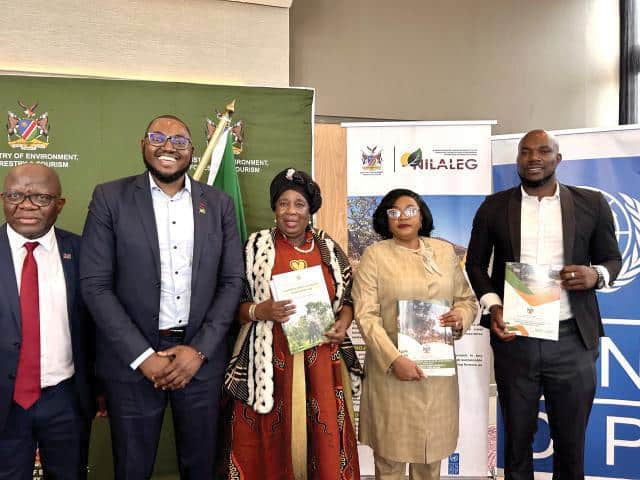
In a country where landscapes often define both identity and survival, Namibia’s forests remain among its most overlooked natural assets. Yet in April 2026, a significant step was taken toward changing that narrative with the official launch of three new state forest reserves – Hamweyi in Kavango West, Kanovlei in Otjozondjupa and Zambezi State Forest in the Zambezi Region.
Together, the reserves represent more than 175,000 hectares of protected woodland ecosystems. Gazetted in 2022 and now moving into active management, they form part of a broader national effort to strengthen conservation, improve biodiversity protection, and create sustainable opportunities for rural communities that depend directly on forests for their livelihoods.
At the heart of this effort is the NILALEG project – the Namibia Integrated Landscape Approach for Enhancing Livelihoods and Environmental Governance – implemented with support from the Global Environment Facility (GEF) and the United Nations Development Programme (UNDP). Through NILALEG, Namibia is pursuing a model that views conservation not as a restriction on development, but as a foundation for long-term economic and social resilience.
Speaking at the official launch ceremony in Windhoek, Minister of Environment, Forestry and Tourism Hon. Indileni Daniel described forests as “pillars of economic stability, social well-being and national resilience.” It is a sentiment reflected in the structure of the reserves themselves.
Unlike traditional conservation models that separate people from protected landscapes, these state forests are designed around community partnership. Local communities remain active participants in the sustainable management of the reserves, with continued access to grazing, firewood, medicinal plants, thatching grass and other forest resources. This approach recognises that conservation success in Namibia is inseparable from the wellbeing of the people living alongside these landscapes.
The scale of the new reserves is substantial. Zambezi State Forest spans more than 142,000 hectares, while Kanovlei covers nearly 22,000 hectares and Hamweyi over 11,000 hectares of ecologically important woodland savanna. These forests provide habitat and movement corridors for wildlife species including elephants, kudu and numerous bird species, while also playing a critical role in protecting soils, storing carbon and supporting climate stability.
Through the NILALEG project, the reserves are now supported by structured management plans, governance systems and community engagement strategies aimed at ensuring long-term sustainability. The project focuses on three interconnected priorities – healthier ecosystems, stronger livelihoods and improved environmental governance.
Importantly, the initiative also opens the door to emerging economic opportunities linked to sustainable natural resource management. From forest-based enterprises and eco-tourism potential to future carbon finance and biodiversity-linked investment opportunities, the reserves position Namibia to increasingly view its forests as valuable natural capital.
At the same time, the challenges remain real. Illegal logging, uncontrolled wildfires, poaching, land clearing and unsustainable harvesting continue to threaten woodland ecosystems across the country. Effective management, law enforcement and strong collaboration between government, traditional authorities, communities, and conservation partners will be essential to ensuring these reserves fulfil their promise.
For communities living in and around these forests, the benefits extend beyond environmental protection. The reserves represent livelihood security, sustainable access to resources and greater participation in decisions that shape the future of their landscapes.
The launch of Hamweyi, Kanovlei and Zambezi State Forests therefore marks more than the expansion of Namibia’s protected area network. It reflects a growing recognition that conservation, community wellbeing and economic resilience are deeply interconnected.
Through the support of the NILALEG project, Namibia is laying the groundwork for a future where forests are not simply protected spaces on a map, but living landscapes that sustain biodiversity, strengthen rural livelihoods and contribute meaningfully to the country’s long-term environmental and economic future.