How Namibia can make astronomy accessible

The question is not whether Namibia has the right skies. It does arguably the finest on Earth, dark enough and clear enough that the Milky Way casts its own faint shadow across the desert floor. The question is whether a child growing up beneath those skies is given any reason to look up with scientific curiosity, rather than simply with wonder. In the past two decades, regions that once occupied the margins of global astronomy Latin America and Southeast Asia have answered that question with conviction. Their methods are instructive, and Namibia would do well to study them.

Latin America built its astronomy community not through a single grand gesture but through a network of small, targeted interventions that accumulated over time. The most visible of these is the Latin American Astronomy and Astronautics Olympiad, a regional competition that brings together middle school students and teachers from across the continent to test their knowledge and kindle their ambition. Its founding logic was simple: competitive events create aspiration in a way that textbooks alone cannot. A student who has prepared, travelled and represented their school or country returns home as an advocate. The Olympiad’s founders also pushed for astronomy to be formally taught in Latin American schools and over time, in a number of countries, it has been. At the university level, the Cenca Bridge programme demonstrated what mentorship across borders can achieve. Founded by astronomers from Central America and the Caribbean who had navigated elite institutions with little support, Cenca Bridge connects undergraduate students in the region with graduate-level guidance, paid internships, and pathways to postgraduate study worldwide. Funded initially by a modest grant from the International Astronomical Union’s Office of Astronomy for Development, it has since sent participants to graduate schools and inspired them to build programmes of their own. The model is self-replicating: those who were helped feel compelled to help others. Colombia added a further strand through citizen astronomy, using remote access to professional telescope networks to let secondary school students in under-resourced communities conduct real observations. The lesson here was that access to professional infrastructure need not wait for a country to build its own.

“Namibia already has the telescope. It already has the skies… What it needs now is the decision that its children will not be left to wonder at the universe alone.”

Southeast Asia’s transformation is perhaps the more striking parallel, because it happened in countries with large rural populations and uneven infrastructure conditions Namibia shares. Thailand’s turning point was institutional. In 2005 the Thai parliament established the National Astronomical Research Institute with an explicit mandate to bring astronomy to the public, not only to conduct research. Before its creation there had been no adequate national astronomy body in the country at all. Two decades later, the institute’s outreach team reaches 700,000 people a year, including disadvantaged and physically challenged communities. It achieved this through a network of regional education centres spread across the country, an outreach division embedded in the institution from the start, and sustained advocacy to include astronomy in the national school curriculum. Regionally, Southeast Asian nations built a shared astronomy network that allowed smaller, lessresourced countries to contribute to global science through collective weight rather than individual capacity. Working groups on public outreach, education and radio astronomy kept momentum alive between annual meetings. The Philippines complemented this with mobile astronomy sessions that travel to remote communities because a fixed observatory, however well-equipped, serves only those who can reach it. Astronomy education that moves, that goes where children already are, reaches an entirely different population.

Namibia is not starting from nothing. The H.E.S.S. observatory has operated in the Khomas Highland since 2002, placing Namibia firmly on the map of international astrophysics. The University of Namibia holds partnerships with institutions including Oxford, Radboud University and the Netherlands Research School for Astronomy the kind of international scaffolding that Cenca Bridge had to construct from scratch. A mobile planetarium already travels to Namibian schools, run by a student-led team. At NamibRand, the Namib Desert Environmental Education Trust runs astronomy education at Africa’s first gold-tier International Dark Sky Reserve, with outreach programmes extending into schools and communities that cannot reach the reserve in person. The pieces exist. What they lack is coordination, sustained funding, and the kind of national commitment that turned Thailand’s institute from an idea into an institution.

The roadmap is not difficult to sketch. A sustained mobile planetarium programme funded, scheduled, and linked to teacher training and local-language curriculum materials would extend the work already begun. A regional school-level astronomy competition open to southern African countries, perhaps convened through the Square Kilometre Array Organisation that already spans the continent, would create the aspirational pull that the Latin American Olympiad created elsewhere. A formal mentorship programme pairing University students with researchers at partner institutions abroad, supported by IAU development grants, would show young Namibians that international careers in astronomy are not closed to them. And a portion of revenue from dark sky tourism — an industry that depends entirely on the same skies children grow up beneath channelled back into school astronomy programmes would create a self-reinforcing loop between economic and educational development.

Thailand did not wait until it had a world-class telescope before deciding to teach its children about the stars. Brazil did not wait for perfect conditions before staging a competition that made tens of thousands of young people feel that science was something they could do. Namibia already has the telescope. It already has the skies, the international partnerships, the mobile planetarium, and the recognised dark sky reserve. What it needs now is the decision, clear, funded, and sustained that the children growing up beneath one of the universe’s finest natural classrooms will not be left to wonder at it alone.

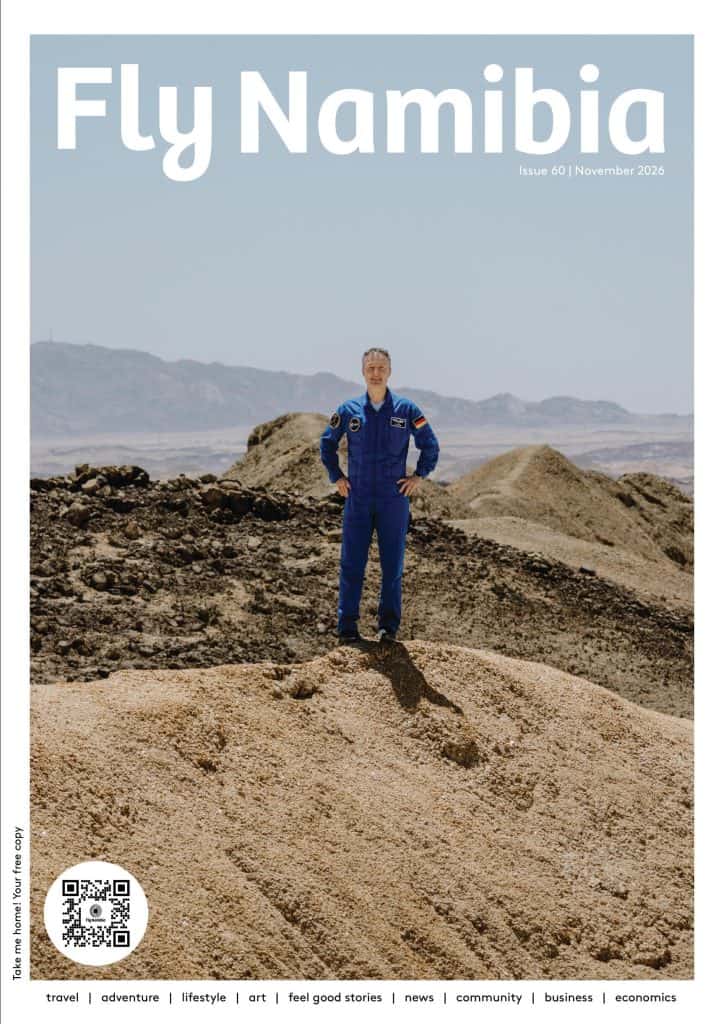
From the November 2026 issue

Share:

More Posts

NOMAD Community Arts Project

Discover NOMAD Community Arts Project in Swakopmund, where Karin Retief brings women together through free recycled-art workshops that build skills,
We’re for Namibians: Agnes Shivute

Agnes Shivute’s Native Leaves introduces Namibian children to indigenous plants through interactive booklets, planting seeds of conservation education and cultural
Sign up for our newsletter