How Namibia can make astronomy accessible
How Namibia can make its world-class dark skies accessible to children through education, drawing lessons from Latin America and Southeast

We live in a world that constantly asks us to become more. More productive. More successful. More accomplished. More available. We are encouraged to pursue bigger goals, build meaningful careers, maintain relationships, raise families and somehow find the energy to keep everything together. In the midst of these demands, we can become so consumed by who we are expected to be that we gradually lose touch with who we really are.
The paradox of modern life is that we are more connected than ever, yet increasingly at risk of becoming disconnected from ourselves.
Identity is more than our names, professions, relationships or social roles. From a psychological perspective, identity encompasses our values, beliefs, experiences and the internal sense of who we are. It gives us continuity through change, influences our decisions and shapes how we understand our place in the world.
However, in a fast-paced society, identity can quietly become something we perform rather than something we experience. We learn to measure ourselves by productivity, achievement, appearance and the approval of others. We begin to associate our worth with what we accomplish rather than who we are.
Social media can intensify this process. We are constantly exposed to carefully curated versions of other people’s lives – their achievements, relationships, careers and milestones. Although comparison is a natural human tendency, repeated exposure to these idealised portrayals can distort our perception of what a successful or meaningful life should look like.
We may find ourselves pursuing goals we never consciously chose, adopting expectations that do not align with our values and feeling inadequate despite objectively making progress. Without realising it, we begin living in response to the world rather than in alignment with ourselves.
As human beings, we occupy multiple roles. We may be professionals, parents, partners, friends, caregivers and leaders. Each role carries expectations and responsibilities, and many of them are deeply meaningful. The challenge arises when these roles begin to consume our entire sense of self.
We become so accustomed to meeting other people’s needs that we struggle to identify our own. We become so focused on fulfilling our responsibilities that we forget what brings us joy beyond them. We become so committed to being dependable that we find it difficult to admit when we are exhausted, uncertain or simply need a moment to breathe. Over time, this disconnection can leave us feeling emotionally depleted, directionless or unfamiliar with ourselves. The problem is not that we have multiple roles; it is that we can begin to mistake our roles for our entire identity.
You are more than what you do for a living. More than the responsibilities you carry. More than the expectations you meet. And certainly more than what other people perceive you to be.
“The paradox of modern life is that we are more connected than ever, yet increasingly at risk of becoming disconnected from ourselves.”
Identity is not static. Throughout our lives, we evolve through relationships, adversity, parenthood, career transitions, loss and personal discovery. We outgrow certain beliefs, reconsider our priorities and develop new perspectives. Change is not a threat to identity; it is part of being human. Psychological development involves integrating these experiences into an evolving understanding of ourselves. We can become more confident, more compassionate, more ambitious or more intentional without abandoning the values that ground us.
The distinction lies between growing into a fuller version of yourself and becoming someone you believe you must be to earn acceptance. One is driven by authenticity and personal meaning. The other is often driven by fear – fear of falling behind, disappointing others, being judged or not being enough.
This raises an important question: Is the life I am building a reflection of who I am, or a response to what the world expects of me?
It is a question worth asking whenever our ambitions begin to cost us our peace, our relationships or our connection to ourselves.
Protecting our identity in a fast-paced world does not require us to withdraw from society or abandon our ambitions. It requires us to become more intentional about how we live. It begins with self-reflection: creating space to examine our values, recognise our emotional needs and question the expectations guiding our choices. It means learning to distinguish between what genuinely matters to us and what we have been conditioned to believe should matter.
It also requires boundaries. Saying no to certain demands is not necessarily selfish; sometimes, it is about protecting the commitments and values that matter most. Resting does not make us unproductive, and changing direction does not make us failures.
Perhaps most importantly, we must learn to separate our worth from our output. We are not more valuable on the days we accomplish everything, nor are we less worthy when we struggle, pause or begin again.
Sometimes, finding ourselves does not require becoming someone new. It requires letting go of the expectations that have made it difficult to recognise who we already are.
In a world that constantly rewards visibility, achievement and speed, there is something profoundly powerful about knowing who you are when no one is watching.
It is the ability to pursue success without allowing it to define your worth. To celebrate other people’s journeys without diminishing your own. To embrace change without losing sight of your values. And to build a life that feels meaningful from the inside, not merely impressive from the outside.
You do not have to keep up with every trend, meet every expectation or become every version of yourself that the world rewards. You are allowed to grow at your own pace, redefine your priorities and choose a path that reflects your own understanding of a meaningful life.
Perhaps the most important question is not whether we are doing enough, achieving enough or becoming enough. Perhaps it is whether, in the pursuit of all these things, we are still connected to ourselves. In a world that rarely slows down, the greatest act of self-preservation may be learning to pause long enough to recognise yourself again.
Because success is not only about how far you go. It is also about whether, in getting there, you still recognise the person you have become.
Your identity should be your anchor, not another performance.
Clinical Psychologist
From the November 2026 issue

How Namibia can make its world-class dark skies accessible to children through education, drawing lessons from Latin America and Southeast

Discover NOMAD Community Arts Project in Swakopmund, where Karin Retief brings women together through free recycled-art workshops that build skills,

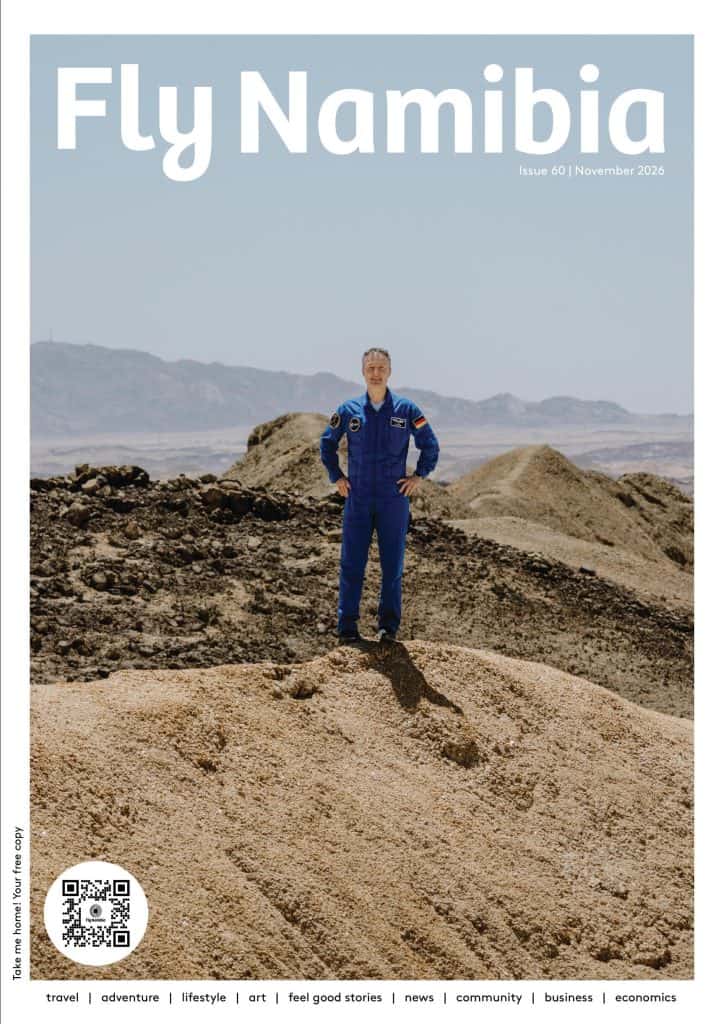
Namibia marks World Space Week 2026 with ESA astronaut Dr Matthias Maurer, spotlighting STEM education, satellite data and the country’s
Agnes Shivute’s Native Leaves introduces Namibian children to indigenous plants through interactive booklets, planting seeds of conservation education and cultural