
From neighbourhood walk to national movement: Inside Cleanup Namibia
Cleanup Namibia, founded by Dr La-Toya Mwoombola-Hamutenya, turns a neighbourhood walk into a national clean-up. First Windhoek activation: 19 September

The physical world rests on three fundamentals. Matter, energy and space. A clock does not detect an independent flow called time. It simply registers its own internal cycles. Whether the mechanism is a swinging pendulum, a vibrating crystal or oscillating atoms, the clock counts how many times a certain configuration of matter completes a cycle while moving through space under the influence of energy. We then give those accumulated cycles a name and call them seconds, minutes or hours.
Time is a derived measurement of movement. It has no independent existence outside the physical processes we choose to count. When we define a standard unit of time, we are selecting one reliable cycle and declaring it to be our reference. That definition remains valid only while the relationship among matter, energy and space inside the measuring device stays constant.
Any alteration in one or more of those three factors changes the rate at which cycles accumulate. Two identical clocks can therefore disagree after one has its factors influenced. The disagreement does not mean time itself has changed. It means one clock has operated under different physical conditions than the other.
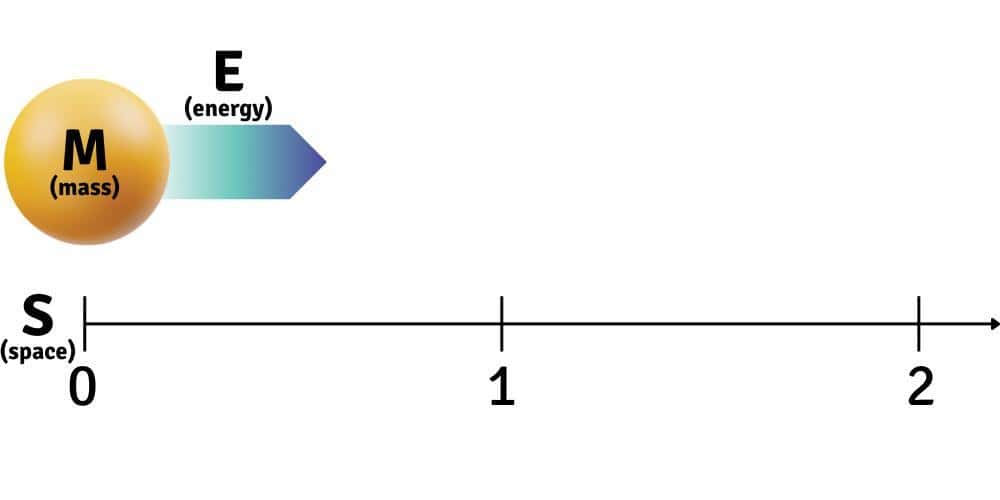
We could define a unit of time as a certain amount of mass with a certain amount of energy across a certain amount of space (distance).
Clocks moving at high speed accumulate different readings from clocks that remain at rest. These differences are real, repeatable and essential for modern technologies.
A pendulum clock on a ship in rough seas experiences constant changes in acceleration. Energy is added and removed from the pendulum in varying amounts. The relationship between its mass, the effective pull it feels, and the distance of each swing is no longer steady. Its rate therefore drifts relative to a clock on stable ground.
An atomic clock on an orbiting satellite travels at high velocity, so the electromagnetic signals used to measure the atoms cover longer effective paths. These factors alter how quickly the clock completes its internal cycles. In every case, time dilation arises because the factors of measuring have changed.
Many equations in physics contain time as a variable. Replacing time with the explicit factors of matter, space and energy can make relativistic effects easier to understand and to compensate for in practice.
The equation E = mc² provides a clear illustration. The constant c stands for the speed of light. Speed is distance divided by time. The entire equation is therefore constructed from matter (the mass m), energy (the E on the left), and space (the distance component inside c). Time enters the equation only indirectly through the definition of speed.
Engineers who must apply relativistic adjustments can then reason about the actual physical differences between two situations rather than about an independent time that has somehow dilated. The numerical results remain the same. The thinking that leads to those results becomes more direct.
From the September 2026 issue

Cleanup Namibia, founded by Dr La-Toya Mwoombola-Hamutenya, turns a neighbourhood walk into a national clean-up. First Windhoek activation: 19 September

In Lüderitz, community makers are building penguin and gannet decoys to lure seabirds back to silent islands in Namibia’s NIMPA

FlyNamibia’s “We rise by lifting others” in action: We’re for Namibians stories, the Makers Project and Padel for a Purpose

“I don’t know” is often “I’m not ready to face what I know.” On intuition versus fear — and the