Is “/” a letter of the alphabet? And what about “//” or “!”? And a “q” which is not pronounced, but inserts percussion into a word? Or a ’ which is just a micropause?
In a rather rudimentary room, our small translation team sat around laptops, mixers, microphones and sometimes black tea with bread. The clicks and rich array of expressions in the Ju/’hoan language represent an intersection of modern and ancient languages.
During a playful moment, we discuss which-is-a-sound and which-is-a-letter. If clicks are not mere sounds, but actual alphabet letters, then the Ju/’hoan alphabet has 30 letters. Minus another five from the “normal” (Latin) alphabet which are redundant. Oh well (click!), back to more serious business: we are doing an oral translation of the Bible. Oral, since so few mother tongue speakers of Ju/’hoan are able to read the written form of their language, which had until recently been subject to numerous grave disagreements amongst linguists as to which orthography is the correct one. And meanwhile, native speakers just happily click away.
Translation work is one of the most mentally rewarding and spiritually enriching endeavours. Not only does one get to work with language equivalents; one is also led to think in new ways about the depth and height, the breadth and width of divine love. Besides, there are positive spin-offs benefitting the holistic development of the language. The final spoken product also finds its way onto an app where anyone with a phone can listen to it, the Ju/’hoansi people behind the recordings are giving a voice to their own pain and pleasure for the world to hear, with a sense of genuine experience overlaying their words. The word Ju/’hoansi means “naked people” – those who knew how to survive in the expanses of northeastern Namibia, now no longer “naked” – but “clothes don’t maketh the man”.
In time, Ju/’hoan will be transcribed and read more and more, helping the language to further develop and find its rightful place alongside the other Namibian languages. A language uniquely concise yet rich will enter the world of subjects both written and spoken.
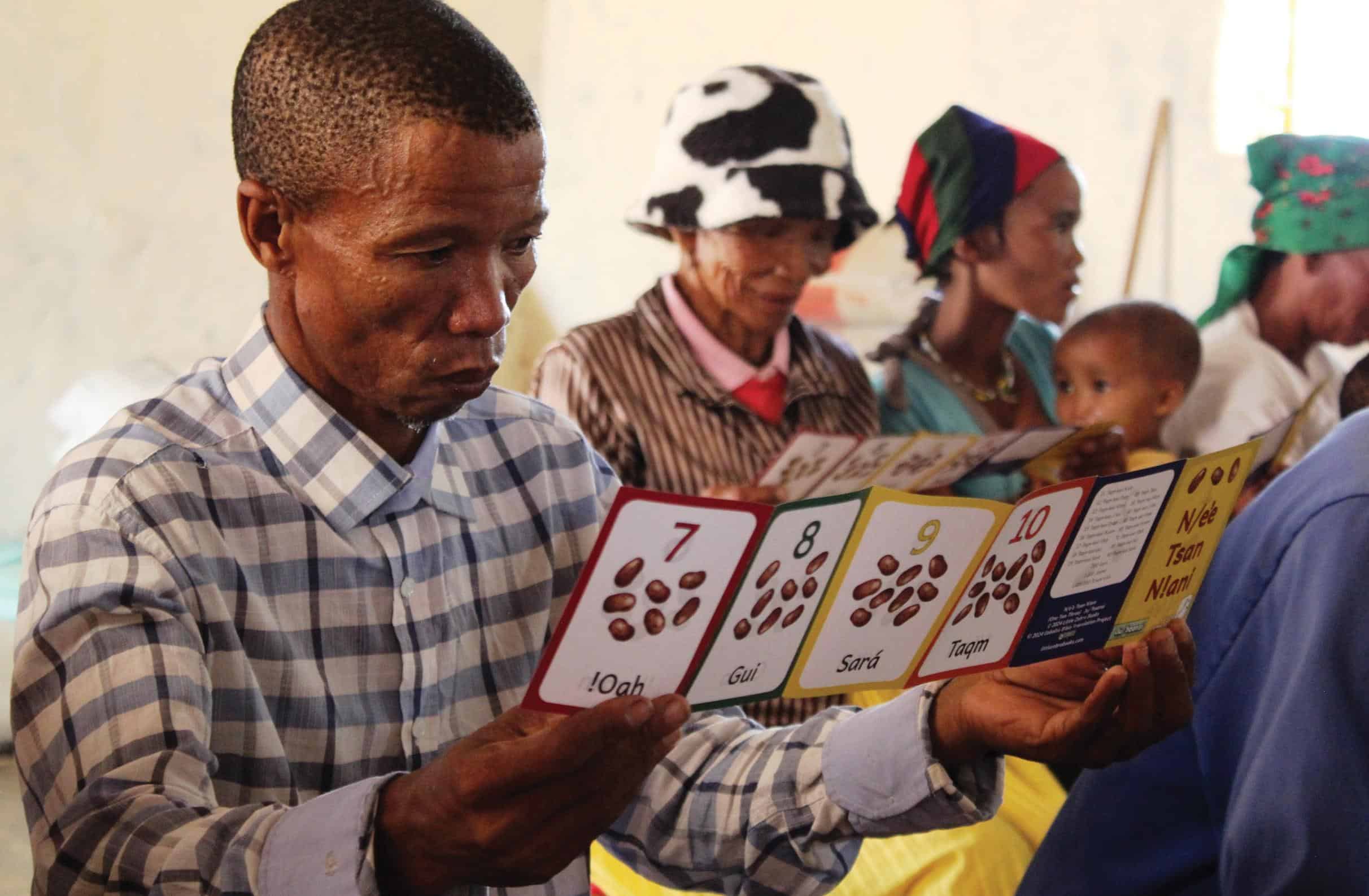
Which brings us to the subject of numbers. How do the Ju/’hoansi count? For Bible translators, this became an obvious question, with tens, thousands and millions appearing in the text, as well as verse numbers and so on. The native speakers looked critically at their conventional way of counting and, though beautifully intriguing, they found it cumbersome: five was “one hand”, six translated to “one hand and one thing”, ten was “two hands”, while twenty was known as “two hands and two feet.” Just imagine what a hundred and twenty-six might sound like, not to mention thousands or millions!
As a result, the translators – Xole Guta, //’!Ao Abusema, N’/i!ao Timi and //’!Ao Chapman – designed a completely new counting system for their own language. Tradition is neither stagnant nor does it need to borrow from others – it evolves from within. This is how they conceived it: For six: “circle-below” (!kxam); seven: “broken” (!oah); eight: “circle-above” (gui); nine: “incomplete” (sará) and ten: a new word, “taqm”, like a string being plucked. What would a hundred be? They remembered how the older generation conflated hundred with “hoender” (chicken). So, let’s keep it that way, for fun and function. Therefore, hundred is “ghoro”. And which animal will a thousand be? The millipede, of course, “tcoma”.
And a million? Look up to the stars, count them if you can… Tcxum. So, ten million four hundred thousand will be “tcxumsa o taqm kesi ghorosa o tcomasa o //xai”, evoking stars, millipedes and chickens as you count. Short, sweet and playful. Count me in (though it will take lots of practice)!