The history of medicine seems to revolve around plants. There was a time when they were mostly consumed in their natural state. Traditional healing experts knew the right dosage, how to prepare it and how it would affect the body.
Today, with advanced science, the knowledge is based on the bioactive compounds contained in the medicine administered as per the diagnosis – whether it is a syrup, powder or tablet. The historic and modern approach are not all that different, though, with the common denominator being the molecular composition. Both intend to heal, although the mode of administration differs – while one administers it in its natural state or with minimal adjustments, the other processes it to the extent of sometimes changing its natural state.
The devil’s claw, also called the grapple plant, is one of the earliest plants known for its medicinal properties. We have two prominent species here in Namibia: Harpagophytum procumbens of the subspecies procumbens and Harpagophytum zeyheri of the subspecies sublobatum. The procumbens species is found almost throughout Namibia, except in the dry Namib Desert, while the latter is concentrated in northern Namibia, particularly the Kavango and Zambezi regions extending towards Angola. Science can become a very complex study, but the different subspecies can be explained in these simple terms: every individual has a name (or names) and a surname. The naming of plants can be viewed in the same way.
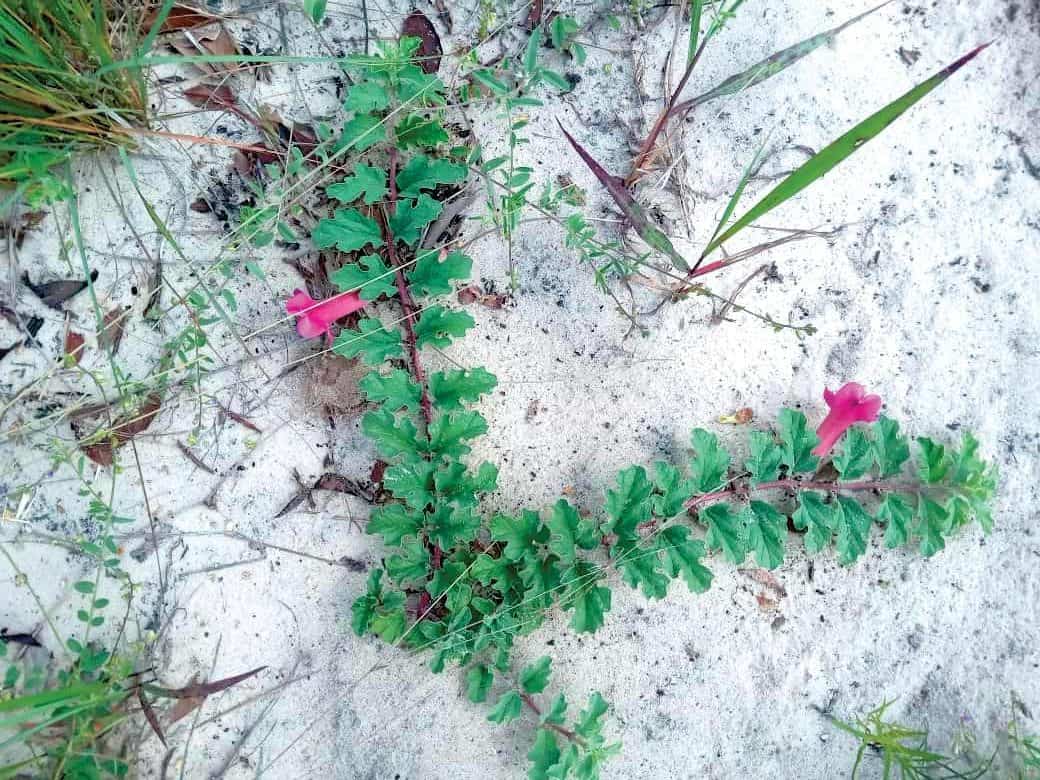
The devil’s claw derives its name from its physical appearance – a fruiting body with sharp hooks extending from the fruit. This rather weird structure allows it to attach to almost anything which aids seed dispersal. The devil’s claw has purple flowers with an orange-yellowish colour on the lower inside of the petals while it has irregularly shaped leaves. The plant grows by extending on the surface of the soil and has tubers of different sizes underground. One can compare its growth and appearance to that of a sweet potato plant, especially the flowers and the underground tubers. My first time seeing this iconic medicinal plant almost felt like the guide was pranking us, because the plant can easily be mistaken for a useless weed, especially with the absence of the flowers.
Unlike most plants, where the most important part is the fruit, the devil’s claw has a strong tap root from which the secondary tubers develop. These tubers are where the “gold” is stored. They contain active ingredients which are extracted and added to health products that are sold commercially. A distinct difference between the two devil’s claw species is that Harpagophytum procumbens is said to have a higher concentration of the active ingredients and is therefore preferred to Harpagophytum zeyheri.
The San communities are known to be the experts in using devil’s claw tubers as a traditional medicine for treating fevers and sores, among other illnesses. With research, the devil’s claw has become one of the most sought-after plants, its tubers being harvested annually for processing quality products ranging from medicine for humans to veterinary herbal remedies. Harvesting of devil’s claw tubers usually happens around March to October – the time when the rainy season has come to an end. The tubers are usually cut through vertically. They are then placed on elevated nets to sun-dry, allowing moisture to evaporate at a faster pace. Harvesting of devil’s claw is controlled, because the plant is listed as a protected species, which also means a permit is required to harvest, trade or export it.
While devil’s claw populations are healthy and cultivation could be considered if ever the need would arise, my main concern is around the poaching of such precious plants. Just the other day, an alarming figure of 295 poached elephant’s foot plants surfaced on my news feed. As an environmentalist, I acknowledge that the broader public is often informed about plant dynamics, but maybe the public is not always aware of the laws protecting the plants in terms of harvesting, trading and exporting. Plant poaching is a crime, and we should refrain from it.